
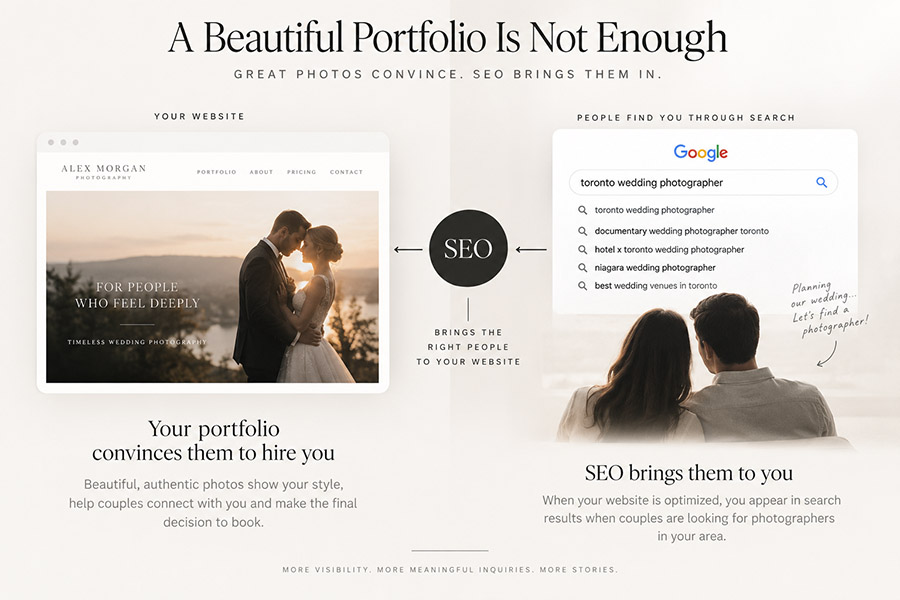
SEO for wedding photographers is about much more than adding keywords to a website. A strong photography site should showcase beautiful work, but it should also help the right couples discover that work through Google, understand your experience, explore the weddings and venues you have photographed, and take the next step toward contacting you.
In addition, this guide is written for working photographers who want a practical, modern approach to search engine optimization. More importantly, we will cover search intent, site structure, wedding venue SEO, blogging, image optimization, local search, backlinks, AI-assisted search, internal linking, technical performance, and the metrics that actually matter for a photography business.
What Is SEO for Wedding Photographers?
In other words, SEO stands for search engine optimization: the practice of improving a website so search engines can understand its content and people can find it when they search for relevant information or services. If you want a broader definition, Wikipedia’s overview of search engine optimization is a useful starting point.
In practice, SEO for a wedding photographer is not one tactic. Instead, it is the combined effect of your website structure, page topics, written content, photographs, internal links, external links, local relevance, reviews, technical performance, and reputation.
For example, a couple might search for:
- Toronto wedding photographer
- documentary wedding photographer Toronto
- Niagara wedding photographer
- Hotel X Toronto wedding photographer
- Paletta Mansion wedding photos
- best wedding venues in Niagara
- Toronto engagement photo locations
- how many hours of wedding photography do I need
For example, those queries represent different levels of intent. For example, someone looking for “wedding photography ideas” may only be gathering inspiration. In contrast, someone searching for a photographer at a venue they have already booked may be much closer to sending an inquiry.
Therefore, this leads to one of the most important principles in SEO for wedding photographers: do not optimize only for traffic volume. Therefore, optimize for the people who are most likely to become the kind of clients you want.
Search Intent and SEO for Wedding Photographers
First, keyword research becomes much more useful when you stop viewing every keyword as equal. For example, a search query tells you something about what the person needs right now.
1. Inspiration searches
Examples include “wedding photography ideas,” “editorial wedding photos,” or “romantic engagement photo ideas.” These searches can bring a lot of visibility, but the visitor may still be months away from choosing a photographer.
2. Style and research searches
Similarly, queries such as “documentary wedding photographer Toronto” or “film inspired wedding photography” suggest that the couple is beginning to compare photographers, styles, and approaches.
3. Venue and location searches
In addition, searches such as “Hotel X Toronto wedding photographer” or “Martin Estate wedding photos” can be especially valuable. Consequently, the person may already have a venue and may now be evaluating photographers who understand that location.
4. Planning searches
For example, questions such as “how many hours of wedding photography do we need?” or “when should we do family photos?” create opportunities for educational content that can build trust before the couple contacts you.
5. High-intent commercial searches
Finally, queries such as “Toronto wedding photographer prices,” “Niagara wedding photographer,” or “wedding photographer available in Toronto” are much closer to a booking decision.
As a result, a smart strategy for SEO for wedding photographers serves several stages of this journey instead of chasing only one broad keyword.
Website Structure and SEO for Wedding Photographers
At the same time, a photography website should not be a random archive of galleries and blog posts. Therefore, important pages should have distinct purposes, and those purposes should be clear to both visitors and search engines.
For example, a strong structure might include:
- Homepage: your primary service and primary market.
- Core photography page: a clear overview of your wedding, engagement, and family photography.
- Regional service pages: only for areas you genuinely serve and can support with unique content.
- Wedding venue hubs: collections of useful venue resources for a region.
- Individual venue guides: evergreen pages designed around a specific venue.
- Real wedding stories: proof of experience and supporting content.
- Educational guides: answers to practical questions couples are searching for.
- Investment and inquiry pages: clear routes from discovery to conversion.
On our own site, for example, visitors can move from our photography portfolio to our wedding galleries, review photography and videography investment options, and then send an inquiry. That path is useful to a person and also creates clear internal relationships between important pages.
Good SEO for wedding photographers is therefore partly an information-architecture problem: the website must make sense as a system, not only as a collection of beautiful pages.
Wedding Venue SEO for Wedding Photographers
In addition, wedding venue searches are unusually valuable because the venue is often selected before the photographer. After booking, couples frequently search for examples, planning advice, portrait locations, timelines, and photographers who already understand the property.
Consequently, that creates queries such as:
- Wedding photographer at [venue name]
- Wedding photos at [venue name]
- Ceremony examples from [venue name]
- Best photography locations at [venue name]
- Wedding cost or planning guide for [venue name]
Wedding Venue SEO: Create Hubs, Not a Pile of Unrelated Posts
If you photograph across Niagara, for example, one useful evergreen page could be “Best Wedding Venues in Niagara.” That hub could link to individual venue guides, and each venue guide could link to one or more real weddings.
Therefore, the hierarchy becomes simple:
Region → Venue Guide → Real Wedding
As a result, each page has a clear job, and internal linking becomes more intuitive.
Wedding Photographer SEO Should Use First-Hand Experience
Instead of copying a venue’s marketing language and simply adding your photographs, build the page around first-hand observations: the direction of light, the strongest portrait locations, rain alternatives, family-photo logistics, walking distances, ceremony timing, sunset opportunities, reception lighting, and anything that can help a couple plan the day.
Google’s own guidance recommends creating helpful, reliable, people-first content and specifically asks whether a page demonstrates first-hand expertise. For photographers, that is a major advantage: you have actually worked in the spaces you are describing.
For SEO for wedding photographers, a sentence based on real field experience is usually more valuable than a paragraph of generic venue copy.
Real Weddings and SEO for Wedding Photographers
At the same time, real wedding posts are still valuable. They show a complete body of work rather than a small portfolio edit, and they prove that you can handle changing light, ceremony moments, family photographs, portraits, speeches, receptions, and unpredictable situations.
However, the problem appears when five weddings at the same venue all target exactly the same phrase.
Instead, keep one strong evergreen venue guide as the main resource rather than creating several pages called “[Venue] Wedding Photographer.” Then make real weddings more specific:
- Winter Wedding at [Venue]
- Black-Tie Summer Wedding at [Venue]
- Rainy Fall Wedding at [Venue]
- Outdoor Jewish Wedding at [Venue]
- Intimate Weekday Wedding at [Venue]
As a result, the venue guide can link to those weddings, while the wedding stories link back to the venue guide. As a result, this reduces unnecessary overlap while allowing each article to add something new.
Moreover, a real wedding gives you original photographs that reinforce the claims you make. For example, if you say a terrace is strong at sunset, show an actual sunset portrait there. Similarly, if you recommend an indoor rain location, show a real photograph made in that space.
Internal Linking and SEO for Wedding Photographers
First, internal links are links between pages on your own website. They are simple, but they are one of the easiest ways to improve navigation and help search engines understand relationships between topics.
For example, a Niagara wedding story can link to your Niagara service page. Meanwhile, the venue guide can link to the real wedding photographed there. Meanwhile, a wedding-planning article can point readers toward your pricing page. Finally, your portfolio can link directly to your contact page.
In addition, use descriptive anchor text. “See our full wedding galleries” is more useful than “click here.” If someone is reading this guide and wants to see how these ideas translate into real work, they can browse our real wedding galleries or learn more about our approach on the About Nadtochiy Photography page.
Internal linking is an important part of SEO for wedding photographers because it turns isolated pages into a connected subject library.
Location Pages and SEO for Wedding Photographers
Similarly, location pages can be effective when they represent real markets you serve. However, they become weak when dozens of near-identical pages are generated and only the city name changes.
For example, a useful location page should contain information that belongs specifically to that place:
- real weddings or sessions photographed there;
- venues you know;
- local portrait locations;
- seasonal or logistical considerations;
- relevant travel information;
- original photographs from that market;
- links to deeper local content.
If you cannot make a location page genuinely different and useful, it may be better to build the content first rather than publishing a thin page simply to target a city name.
Image SEO for Wedding Photographers
For most businesses, images support the content. For photographers, images are the content and the product. Therefore, that makes image optimization a central part of SEO for wedding photographers.
In addition, Google publishes detailed Image SEO best practices, including guidance on descriptive context, alt text, image quality, responsive delivery, and crawlable image elements.
Image SEO for Wedding Photographers: Use Descriptive Filenames
Instead of:
DSC04582.jpg
use something concise and descriptive, such as:
hotel-x-toronto-wedding-rooftop-portrait.jpg
Therefore, a filename should describe the photograph rather than become a string of repeated keywords.
Write alt text for accessibility first
Bad alt text:
Toronto wedding photographer best Toronto wedding photography Toronto photographer wedding
Better alt text:
Bride and groom walking across the rooftop terrace at Hotel X Toronto at sunset
In other words, the second version explains what is actually visible. However, when a venue or city is naturally part of the image context, include it. Therefore, do not force the focus keyword into every photograph.
Image SEO: Choose Strong Representative Wedding Images
Similarly, your featured image should clearly represent the page. For example, for a venue guide, a photograph that shows both the couple and a recognizable part of the venue can be stronger than an abstract detail shot. Similarly, for a real wedding, use an image that immediately communicates the story and visual style.
Do not sacrifice speed for image quality
For example, exporting a 25-megapixel JPEG directly into a blog post is unnecessary. Instead, serve images at appropriate dimensions, compress them carefully, use responsive delivery, and lazy-load images farther down the page.
Local SEO for Wedding Photographers
In fact, SEO for wedding photographers is often local SEO. Couples usually care not only about style but also about where a photographer works, whether they know the venue, and whether travel is practical.
In addition, your website and Google Business Profile should reinforce each other. Keep business information accurate, use the most appropriate business categories, upload strong current photographs, earn genuine reviews, and make sure the website clearly explains the markets you serve.
Therefore, local relevance should appear naturally across your website through real projects and useful information, not through awkward repetition of city names.
Reviews are useful beyond social proof
For example, specific, authentic reviews can help potential clients understand what it is like to work with you. In addition, a detailed review that naturally mentions a venue, city, type of wedding, or part of the client experience is far more persuasive than a generic five-star rating with no context.
However, never script reviews or tell clients exactly what to write. Instead, make the process easy, ask at an appropriate moment, and let couples describe their experience honestly.
Backlinks for Wedding Photographers and Vendor Relationships
Next, consider backlinks. A backlink is a link from another website to your website, and wedding photographers have a natural advantage because every wedding connects them with other businesses: venues, planners, florists, caterers, DJs, makeup artists, dress designers, rental companies, publications, and videographers.
The best approach is not to send strangers messages asking for a link. Instead, create something worth sharing.
Afterward, provide the venue or planner with a useful selection of photographs, credit vendors accurately, publish a genuinely helpful story or venue guide, and let the team know it exists. A venue may choose to feature the images and link back to your article because doing so is useful to their own audience.
As a result, that kind of editorial relationship is more sustainable than chasing large numbers of unrelated links.
For SEO for wedding photographers, relevant wedding-industry links can also reinforce the same geographic and topical signals your website is already building.
AI Search and SEO for Wedding Photographers
Meanwhile, search results increasingly include AI-assisted experiences, summaries, and answers. However, that does not mean photographers need to create a second website for AI or rewrite every page around a new acronym.
However, the durable strategy remains the same: publish information that is useful, accurate, original, technically accessible, and based on real expertise.
This is particularly important because generic informational content has become easy to generate. For example, an article called “10 Wedding Photography Tips” can be produced by almost anyone. In contrast, a detailed guide called “What We Learned Photographing November Weddings in Toronto” can contain observations, photographs, timelines, venue conditions, weather considerations, and decisions that come from actual experience.
Google’s people-first content guidance emphasizes experience, expertise, authoritativeness, and trust. Therefore, for photographers, the “experience” part is a natural strength: real assignments create original information.
AI and SEO for Wedding Photographers: Use AI as an Assistant
For example, AI can help organize notes, improve grammar, outline an article, or turn your own observations into a clearer draft. Moreover, it should not invent what a venue is like, what the light does, or what happened at a wedding you never photographed.
For example, a useful workflow is to start with your own notes:
- outdoor ceremony faces west;
- strong shade beside the main building until mid-afternoon;
- family portraits are easier before cocktail hour;
- ballroom becomes very dark after sunset;
- parking is far from the portrait location;
- best sunset view is behind the vineyard.
Finally, use AI to help structure those facts without changing or inventing them.
Modern SEO for wedding photographers should therefore become more human, not less: the more generic content becomes automated, the more valuable first-hand information becomes.
Technical SEO for Wedding Photographers and Website Speed
Finally, a beautiful photography website can still perform poorly if it is slow, difficult to crawl, broken on mobile devices, or overloaded with scripts and oversized images.
In addition, Google’s documentation on Core Web Vitals explains the main performance metrics used to evaluate aspects of real-world page experience.
Prioritize the basics
- Use an SSL certificate and HTTPS.
- Make sure important pages are indexable.
- Keep navigation simple.
- Use descriptive page titles.
- Fix broken internal links.
- Create and submit an XML sitemap.
- Use canonical URLs correctly.
- Optimize image file sizes.
- Test important pages on mobile.
- Avoid unnecessary plugins and scripts.
However, do not turn technical SEO into an endless optimization project. Therefore, fix the issues that affect crawling, usability, speed, and conversions, then return your attention to the content and experience that make the site worth visiting.
Content Strategy and SEO for Wedding Photographers
In practice, the best content strategy is not “publish as much as possible.” It is “publish pages that have a reason to exist.”
For example, a useful hierarchy for SEO for wedding photographers can look like this:
- Core commercial pages: wedding photography, videography, investment, inquiry.
- Primary market pages: the cities or regions that matter most to your business.
- Venue hubs: curated resources for important wedding markets.
- Venue guides: first-hand, evergreen pages about specific locations.
- Real weddings: visual proof and supporting stories.
- Educational articles: practical questions couples ask before booking.
One wedding can support many pieces of content
Instead, stop thinking of one wedding as one blog post. As a result, one strong wedding can provide photographs for a venue guide, a real wedding story, a regional service page, Google Business Profile, social media, Pinterest, a planner feature, a venue feature, and an educational article about timelines or lighting.
As a result, that approach makes each assignment more valuable without creating duplicate pages.
Update strong pages before constantly creating new ones
In addition, before publishing fifty new posts, audit what is already on your website. Older posts may have strong photographs but weak titles, no internal links, outdated information, oversized images, or no clear relationship to your current services.
Therefore, improving one page that already receives search impressions can sometimes be more productive than publishing another page from scratch.
Measuring SEO for Wedding Photographers: Leads, Not Vanity Metrics
Finally, SEO tools can show rankings, impressions, clicks, backlinks, visibility scores, and dozens of other metrics. They are useful, but they are not the business outcome.
Therefore, the questions that matter are:
- Which organic-search pages generate inquiries?
- What venues generate profitable weddings?
- Where do your best geographic markets come from?
- Do your educational articles attract potential couples rather than only other photographers?
- How effectively do key pages lead visitors toward your investment and inquiry pages?
For example, use Google Search Console to understand the queries and pages that generate impressions and clicks. Next, look for pages that are already gaining visibility, then improve them with stronger information, photographs, internal links, and calls to action.
Ultimately, the goal of SEO for wedding photographers is not to win an SEO score. In other words, it is to create a reliable path from search to trust to inquiry.
A 90-Day SEO Plan for Wedding Photographers
Month 1: Build the foundation
- Clarify your primary service and market on the homepage.
- Confirm that the most important pages have unique titles and one clear H1 each.
- Connect Search Console and review what already receives impressions.
- Improve navigation and internal links.
- Audit image sizes and mobile performance.
- Review your Google Business Profile and business information.
Month 2: Build topical depth
- Create one strong regional venue hub.
- Publish two or three venue guides based on real experience.
- Connect existing real weddings to those guides.
- Add useful planning information rather than generic venue descriptions.
- Optimize featured images, filenames, and alt text.
Month 3: Strengthen authority and conversions
- Update older posts that already have visibility.
- Send strong wedding stories or venue guides to relevant vendors.
- Improve calls to action and links to investment/inquiry pages.
- Review Search Console again and identify emerging queries.
- Repeat the pages and topics that are generating qualified traffic.
Overall, this 90-day approach keeps SEO for wedding photographers manageable. You do not need to publish every day. You need a website that becomes more useful, connected, and authoritative over time.
SEO for Wedding Photographers: Publishing Checklist
Finally, before publishing an important guide, venue page, or wedding story, check the following:
- Does the page have one clear search purpose?
- Is there only one H1?
- Does the title clearly describe the page?
- Is the topic clear immediately in the introduction?
- Have you included original first-hand information?
- Are the photographs your own and relevant to the topic?
- Do important images have accurate alt text?
- Are images compressed and appropriately sized?
- Have you linked to relevant pages on your own website?
- Do authoritative external sources add real value where you link to them?
- Does the page have a clear route to portfolio, pricing, or inquiry?
- Would the page still be genuinely useful if Google did not exist?
Ultimately, if you can answer yes to those questions, you are probably building something more durable than a page designed only to satisfy an SEO plugin.
Is SEO Worth It for Wedding Photographers in 2026?
Yes, but it helps to stop thinking of your website as a portfolio with a blog attached.
For example, your website can become a searchable library of your experience. First, a portfolio shows that you can make beautiful photographs. Meanwhile, a venue guide shows that you understand a location, and a real wedding proves that you have worked there. In addition, an educational article demonstrates expertise, while a regional page establishes local relevance. In addition, reviews build trust, vendor links build authority, and internal links connect the entire system.
Ultimately, the photographers best positioned for search are often the ones who already have the hardest part: years of original photographs, real assignments, real venues, and practical experience. Therefore, the opportunity is to organize that material and make it useful.
In other words, that is the real purpose of SEO for wedding photographers: helping the right people discover your work at the moment they are looking for it.


